Alt text is one of the most overlooked SEO opportunities. Alt Audit generates keyword-rich, descriptive alt text for every image — improving your search rankings while making your site accessible.
Alt text (alternative text) is an HTML attribute that describes the content and function of an image on a web page. For SEO, alt text serves as the primary signal that tells search engines what an image depicts, since crawlers cannot interpret visual content directly. Google uses alt text to index images in Google Images, to understand page context, and to determine relevance for search queries. According to Google's own documentation, "alt text is used in combination with computer vision algorithms and the contents of the page to understand the subject matter of the image." Well-written alt text that naturally includes relevant keywords can improve both image search rankings and overall page relevance.
Source: Google Search Central — Google Images best practices
Google cannot see images. It reads alt text to understand what an image shows — and uses that to rank your pages in image search and web search.
Images with descriptive alt text rank in Google Images, sending extra organic traffic to your pages. Google Images accounts for 22.6% of all web searches according to SparkToro.
Alt text reinforces your page's topic. A page about "running shoes" with matching alt text on product images ranks higher for that keyword cluster.
Proper alt text with width and height attributes reduces layout shift (CLS), improving your Core Web Vitals score — a confirmed Google ranking factor.
As voice and AI search grow (Google AI Overviews now reach 1.5 billion users/month), descriptive image metadata becomes critical for discovery.
Follow these best practices to write alt text that helps both search engines and users with screen readers.
| Image Type | Bad Alt Text | Good Alt Text | Why It's Better |
|---|---|---|---|
| Product photo | product-image.jpg | Red Nike Air Max 90 running shoes, side view on white background | Includes brand, model, colour, angle — matches long-tail queries |
| Team photo | photo | Five developers collaborating around a MacBook in a modern open-plan office | Specific count, action, setting — descriptive and contextual |
| Food image | bread | Fresh sourdough bread loaf with crispy golden crust cooling on a wire rack | Sensory details that match how people search for recipes |
| Chart/graph | chart | Bar chart showing 58% of top 1 million websites have missing alt text | Describes the data, not just the format — AI can cite this |
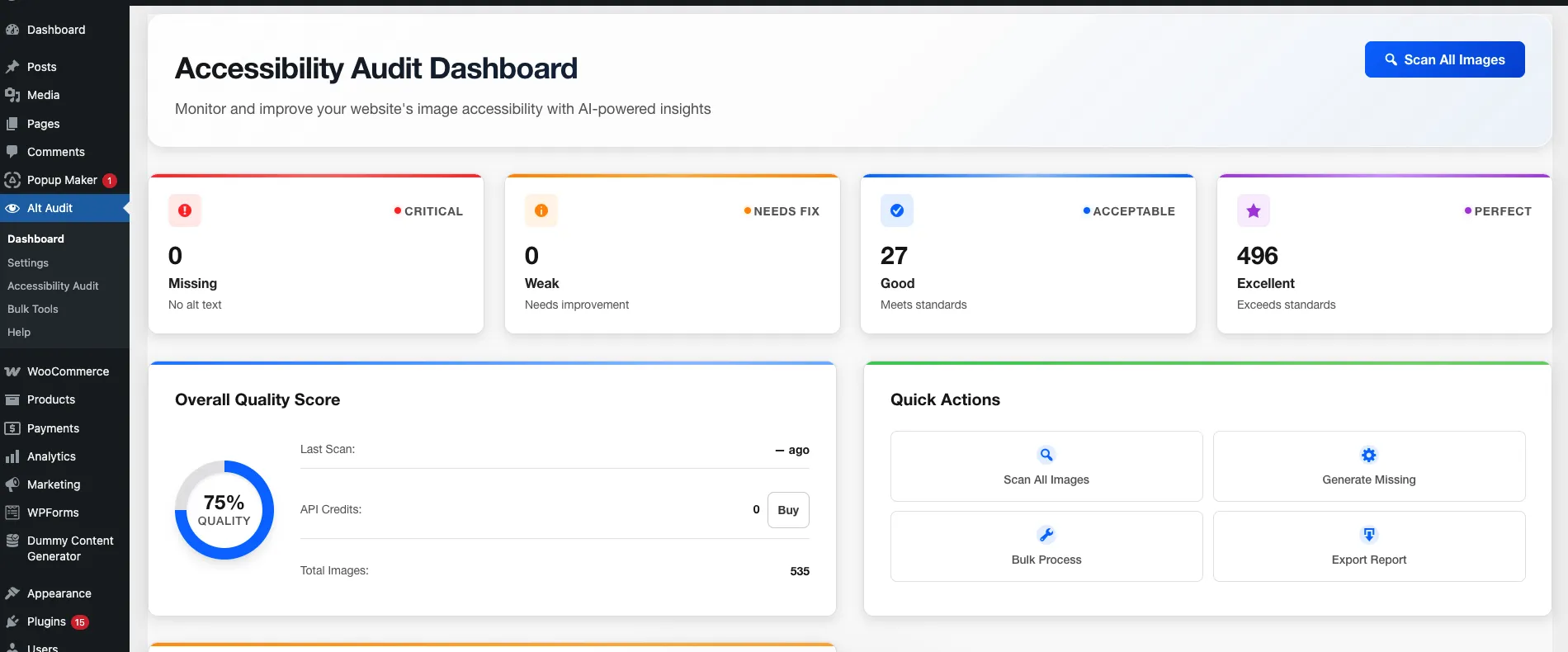
| Screenshot | screenshot | Alt Audit dashboard showing 75% quality score with 535 images scanned | Specific numbers and tool name — builds brand entity signals |
Alt text is a confirmed ranking factor for Google Images and a supporting signal for web search. According to the WebAIM Million 2025 study, 58% of the top 1 million websites have images with missing alt text — making it one of the most common accessibility and SEO gaps. Google's John Mueller has stated that alt text is "one of the most important things you can do" for image SEO. A study by Ahrefs found that pages with optimized image alt text received 40% more traffic from Google Images compared to pages with missing or generic alt text. For e-commerce sites specifically, product images with descriptive alt text appear in Google Shopping results and image packs, directly driving purchase-intent traffic.
Google Gemini identifies objects, context, text, and key elements within the image.
The surrounding page content is used to make the alt text contextually relevant — not just generic.
The result is a natural, descriptive alt text that helps search engines understand and rank your image.
Every product image is an SEO opportunity. Generate alt text for hundreds of product photos at once.
Make every article image discoverable in Google Image Search with descriptive, contextual alt text.
Our WordPress plugin automatically generates alt text when you upload images — zero extra work.
Yes. Alt text is a confirmed ranking factor for Google Images and provides contextual signals for web search rankings. Google uses alt text to understand what an image depicts and how it relates to the page content. Pages with well-optimized alt text rank higher in image search results, which account for 22.6% of all Google searches according to SparkToro data. Alt text also contributes to topical relevance signals that influence overall page rankings.
Keep alt text between 50 and 125 characters. Most screen readers cut off alt text at approximately 125 characters, so staying under this limit ensures accessibility. For SEO purposes, the sweet spot is descriptive enough to include relevant context and keywords, but concise enough to avoid keyword stuffing. Google has stated it uses alt text "in combination with other signals" — quality matters more than length.
Yes, but naturally. Include your target keyword only if it genuinely describes what the image shows. Google's guidelines explicitly warn against "filling alt attributes with keywords (keyword stuffing)" as this creates a bad user experience and may cause your site to be seen as spam. A good rule: write the alt text for a visually impaired user first, then check if a relevant keyword fits naturally.
Alt text (the alt attribute) describes the image content for search engines and screen readers — it is the primary SEO signal. Title text (the title attribute) shows as a tooltip when users hover over an image and has minimal SEO impact. Google has confirmed that the alt attribute is significantly more important than title text for image ranking purposes. Focus your optimization efforts on alt text.
Not if the AI produces accurate, descriptive text. The risk comes from generic or inaccurate alt text — whether written by humans or AI. Alt Audit uses Google Gemini to analyse actual image content and surrounding page context, producing specific and relevant descriptions. The key is accuracy: alt text that correctly describes the image helps SEO, regardless of whether it was written by a human or generated by AI.
Decorative images — borders, spacers, purely aesthetic backgrounds — should have empty alt text (alt=""). This tells screen readers to skip them and prevents accessibility noise. However, be careful about what you classify as decorative. If an image conveys any information, supports the content, or would be missed if removed, it needs descriptive alt text. Product images, infographics, charts, screenshots, and team photos are never decorative.
Use these related pages to move from SEO theory into real audits, image checks, and scalable workflows.
Tool
Check whether your current image descriptions are helping or hurting search visibility.
Guide
See concrete examples, keyword rules, and optimization mistakes to avoid.
Plan
Choose a plan that fits image volume, reporting needs, and recurring optimization work.
Written by
Founder & Web Accessibility Specialist
Full-Stack Laravel & WordPress PHP Developer with a passion for web accessibility. Building Alt Audit to help website owners ensure every image has meaningful alt text for better SEO and inclusivity.
LinkedInFree plan includes 25 credits. No credit card required.
Generate Alt Text FreeWorks with any website — WordPress plugin available